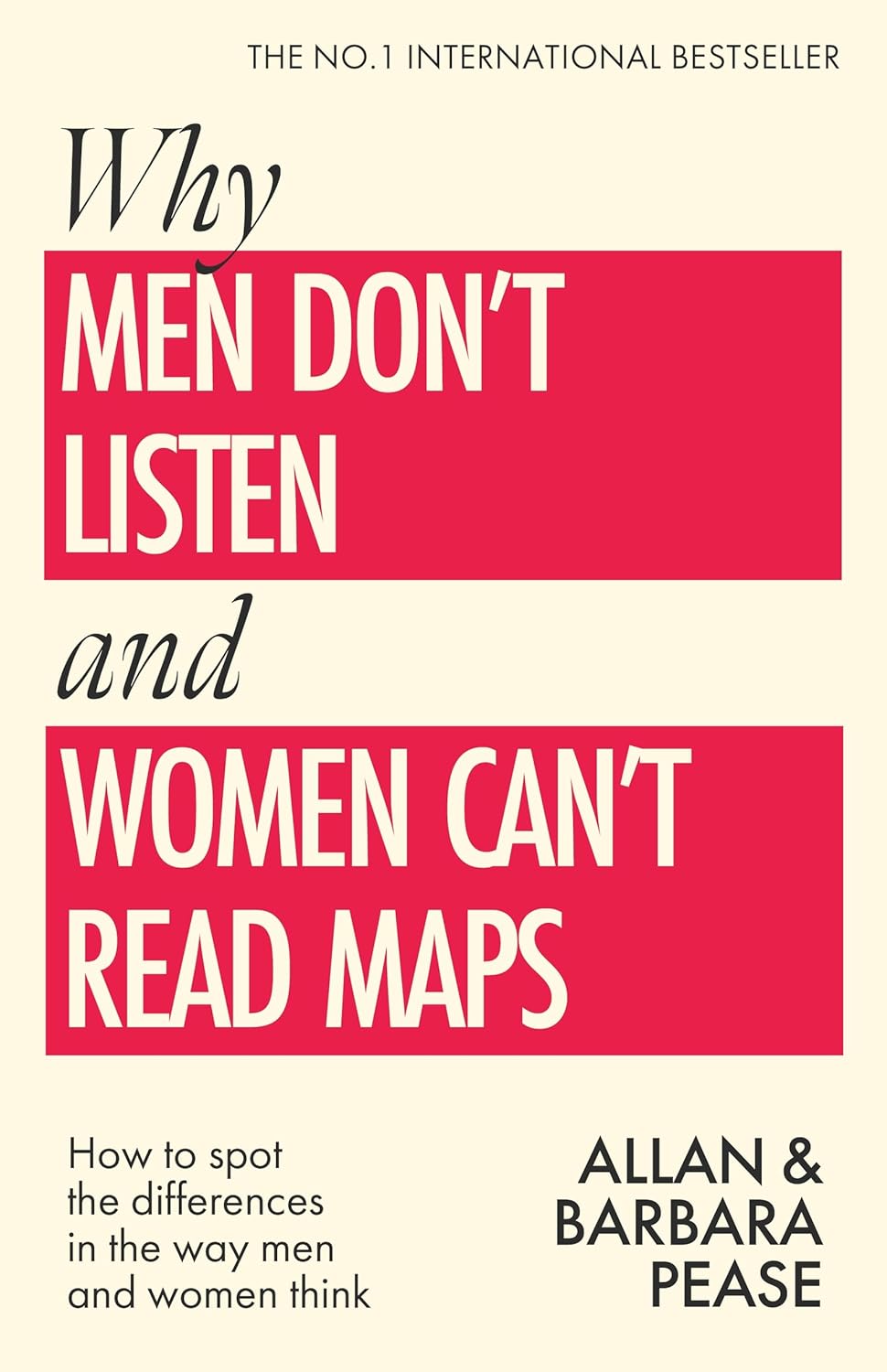
“Why Men Don’t Listen and Women Can’t Read Maps ” by Allen Pease
Who is it for?for those trying to understand the complex world of gender differences
“Why Men Don’t Listen and Women Can’t Read Maps,” written by Allan and Barbara Pease, delves into the complex world of gender differences, backed by psychological and sociological research. The book aims to explore and explain the divergent communication styles, thought processes, and behavioural patterns typically exhibited by men and women.
Throughout the book, the authors employ a humorous and light-hearted tone to discuss a variety of topics, ranging from evolutionary biology to contemporary social dynamics. They argue that many communication issues between the sexes can be attributed to inherent biological and neurological differences. For instance, they discuss how men, generally, may be less adept at verbal communication but have better spatial awareness, while women often excel in language-based tasks and empathy but may struggle with tasks requiring spatial skills.
A significant challenge for readers is the potential overgeneralization of gender traits. While the book is informative and entertaining, its broad generalizations may not apply universally to all men and women. Readers might find that these simplifications don’t always align with their personal experiences or observations.
Another challenge lies in the application of the book’s insights into real-life interactions and relationships. While understanding these general differences can be helpful, navigating personal and professional relationships with this knowledge requires nuance and sensitivity. It’s important for readers to avoid reinforcing stereotypes and instead use this understanding as a starting point for better communication and empathy.
Additionally, the book’s approach and content may not align with contemporary perspectives on gender fluidity and the non-binary nature of gender identity. Readers with a more nuanced understanding of gender may find some of the content outdated or overly simplistic.
In summary, “Why Men Don’t Listen and Women Can’t Read Maps” provides an engaging and simplified exploration of gender differences, with a focus on improving communication between men and women. The challenge for readers lies in critically engaging with its content, applying its insights with caution, and remaining mindful of the complex and varied nature of individual experiences and identities.